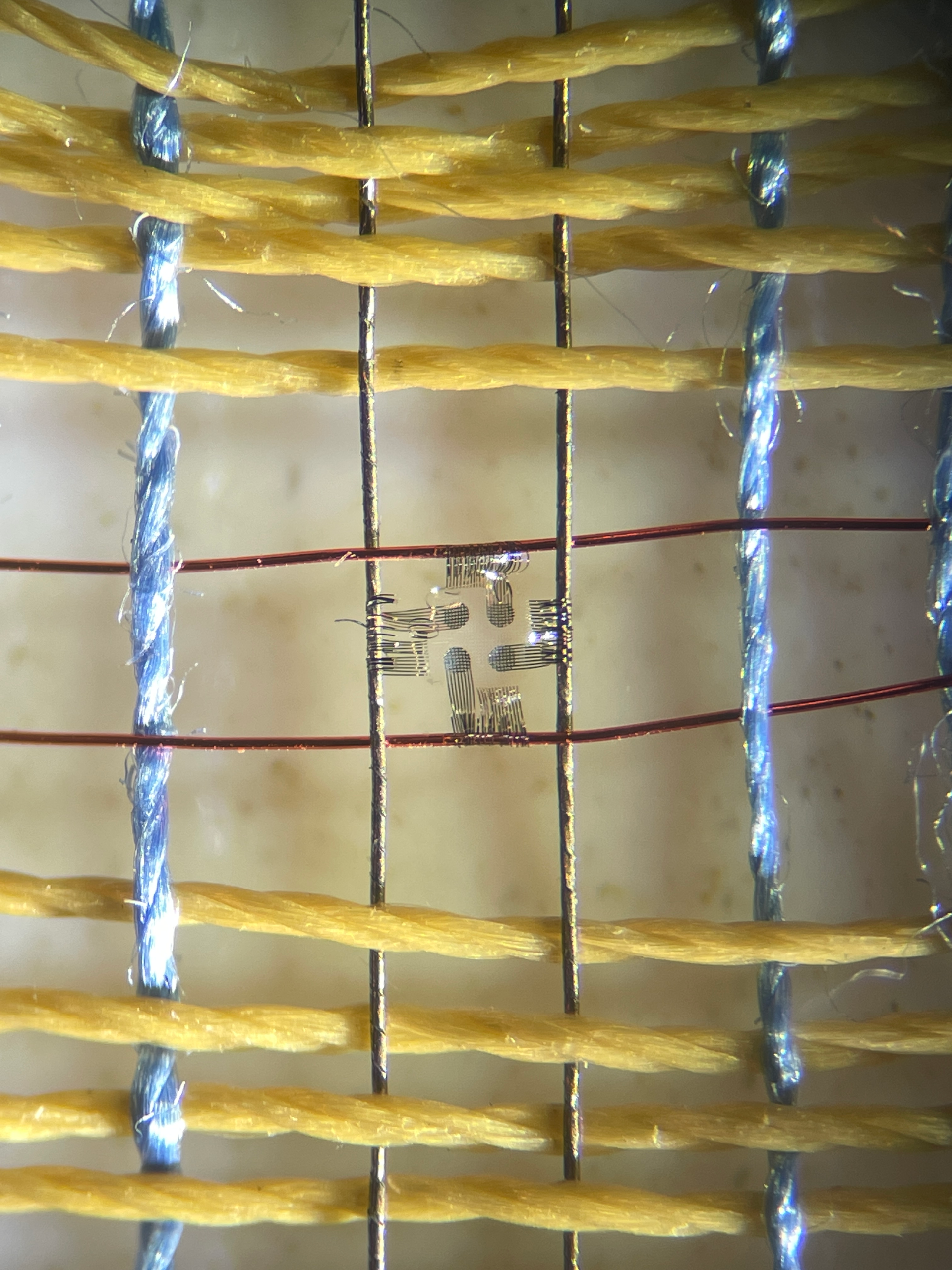
Tiny stressed-out objects tangle with a handwoven mesh. The gaps of this mesh are only 2 to 3 millimeters wide, but that’s huge compared to the scale of microfabricated devices. When stress is deliberately added to this microstructure, similar to how a paper will curl if you stretch and staple a piece of spandex fabric to it, the tips curl up so much that they tangle with individual fibers in the mesh strongly enough to hold on and even carry a small cargo. Handwoven fabrics have a lot of natural variation in fiber diameter, gap width, and overall fuzziness while microfabricated devices are precise down to sub-micron dimensions, but the tiny tanglers are flexible enough to adapt.
Extracted and overlaid from photos of several different tanglers, with a black square representing the tangler’s 0.8 mm x 0.8mm center, these rainbow colored lines show the variety of shapes in the fiber junctions that were successfully grasped.

Prototyping different possible designs for the tanglers involved making some larger scale tubing models to really get a grip on the 3D shapes of woven fabrics up close.
