Author: cindy.harnett@louisville.edu

  • Tiny Tanglers

    tiny microfabricated object grabs a handwoven mesh

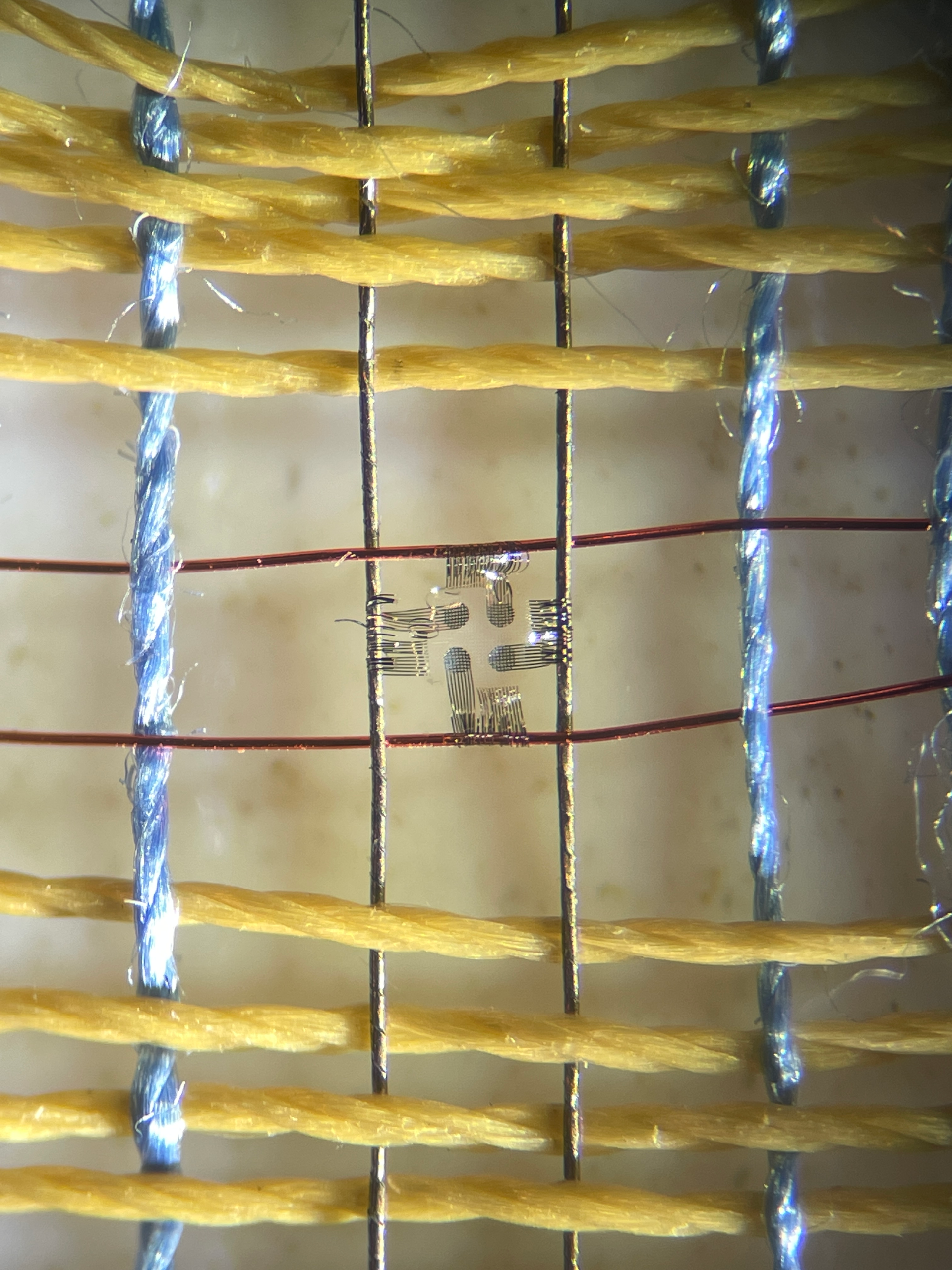
    Tiny stressed-out objects tangle with a handwoven mesh. The gaps of this mesh are only 2 to 3 millimeters wide, but that’s huge compared to the scale of microfabricated devices. When stress is deliberately added to this microstructure, similar to how a paper will curl if you stretch and staple a piece of spandex fabric to it, the tips curl up so much that they tangle with individual fibers in the mesh strongly enough to hold on and even carry a small cargo. Handwoven fabrics have a lot of natural variation in fiber diameter, gap width, and overall fuzziness while microfabricated devices are precise down to sub-micron dimensions, but the tiny tanglers are flexible enough to adapt.

    Extracted and overlaid from photos of several different tanglers, with a black square representing the tangler’s 0.8 mm x 0.8mm center, these rainbow colored lines show the variety of shapes in the fiber junctions that were successfully grasped.

    Prototyping different possible designs for the tanglers involved making some larger scale tubing models to really get a grip on the 3D shapes of woven fabrics up close.

    prototyping for tiny tanglers
  • Trilife: Emerging patterns

    Trilife is a lighting installation where identical modules connect and communicate with their neighbors to create an emerging pattern. Each module connects to three neighbors, and if you get enough modules together, large-scale spirals appear even though there is no centralized control. Randomness comes from temperature fluctuations, meaning the pattern changes each time the array is powered up. Here’s a video of a Trilife array where each module has been soldered by a different student in a learn-to-solder workshop:

    The modules above are fitted with a paper diffuser (printable paper folding pattern given at the link above, along with design and programming files). In a later collaboration with FirstBuild, we came up with these molded plastic covers for a more robust design:

    Circuit boards in the dark with a triangular lightshade
    Trilife boards get a molded plastic diffuser
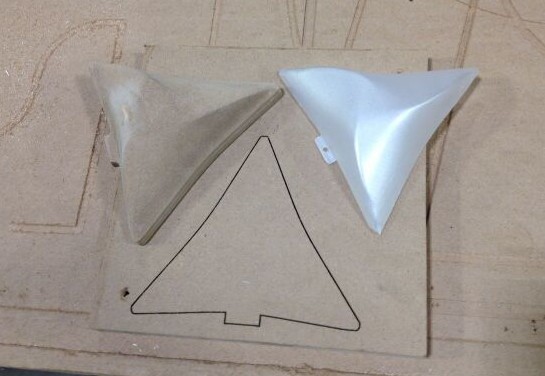
    Makrolon machined mold and die-cut path for the plastic molded diffusers from FirstBuild

    Here, the red LEDs were switched out for white ones. The diffusers were vacuum formed and die cut. They were beautiful and longer lasting than paper diffusers for a long-term installation.

    However, one thing I had liked about the paper was its resemblance to natural objects like a wasp nest or bird nest. All are lightweight objects that follow a general pattern, but grow based on individual decisions about where to put the next element. For a portable or temporary installation I think a pop-up fabric light diffuser would be the best of both worlds.